
Your Court Bundle Matters More Than Your Arguments — A Practical Guide to Getting It Right
Your court bundle is often the single most important thing you bring to a small claims hearing. Here's what judges actually want, based on Practice Direction 27A and the things that make district judges quietly despair.
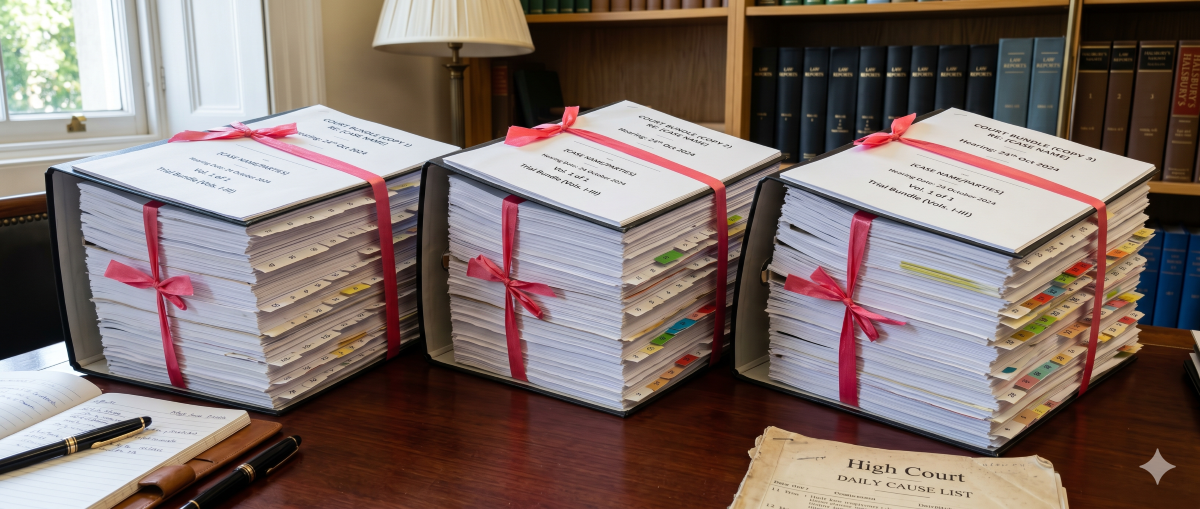
Why Your Bundle Matters More Than Your Arguments
I'm going to make a claim that might surprise you: your court bundle probably matters more than what you say at the hearing.
Small claims hearings are short — typically 30 minutes to an hour. The district judge hasn't read your case in advance (in most courts, they pick up the file that morning). They need to understand the dispute, review the evidence, hear both sides, and make a decision. All in the time most people spend watching an episode of television.
A well-organised bundle means the judge can follow your case. A badly organised one means they're flipping through loose pages trying to find the invoice you're referring to while you stand there waiting. It's widely acknowledged in legal circles that judges can often form an initial view within the first few minutes — and it usually correlates with who brought the better-organised bundle.
That's not because organisation equals being right. It's because organisation equals the judge actually understanding your case.
What the Rules Actually Require
Let's start with what the Civil Procedure Rules say. CPR Part 27 governs the small claims track. Practice Direction 27A paragraph 3.3 is the key provision:
"Not less than 14 days before the date fixed for the hearing each party shall file and serve on every other party copies of all documents (including any expert's report) on which he intends to rely at the hearing."
That's the minimum. File copies with the court and send copies to the other side at least 14 days before the hearing. But "filing documents" is not the same as "preparing a bundle," and this is where people go wrong.
For multi-track and fast-track cases, Practice Direction 32 and the bundle preparation guidance are extensive. Small claims are supposed to be less formal, but judges still appreciate — and in practice expect — documents presented in an organised way.
What "File and Serve" Means in Practice
You need three copies of your bundle:
- One for the judge (filed with the court)
- One for the other party (served on them)
- One for yourself (to refer to at the hearing)
If there are multiple defendants or other parties, each needs a copy. Send the court and the other side their copies at least 14 days before. Don't leave it until the morning of the hearing — judges really don't appreciate that.
What Goes in the Bundle (and What Doesn't)
A good small claims bundle typically includes:
The Core Documents
- Index page — a numbered list of every document in the bundle with page references
- Claim form and particulars of claim
- Defence (and any counterclaim)
- Any replies or additional statements
- Directions order — the court's case management directions
Your Evidence
- Witness statement(s) — even in small claims, a short witness statement helps. It should cover the key facts in chronological order.
- The contract or agreement (if written)
- Key correspondence — the important emails, letters, or messages. Not all of them. The important ones.
- Invoices, receipts, or financial documents
- Photographs (if relevant — e.g., damaged goods, property condition)
- Expert reports (if the court has given permission)
What to Leave Out
This is where most people go wrong. They include everything.
- Don't include 47 pages of email chains where 44 of them say "Thanks, noted" or "See attached." Extract the relevant emails only.
- Don't include duplicate documents — one copy of each, clearly labelled.
- Don't include legal research or case law for small claims hearings. The judge knows the law. If you want to reference a specific point, mention it verbally or in a brief skeleton argument.
- Don't include emotional statements about how the dispute has affected your mental health. Stick to facts and evidence. Small claims judges are deciding legal disputes, not counselling sessions.
A concise bundle of 30-40 pages will serve you far better than a 200-page monster that nobody will read.
How to Format It (Without Overcomplicating Things)
You don't need to be a solicitor to produce a professional-looking bundle. Here's the format that works:
The Index
First page. Numbered list. Each item has:
- A document number (1, 2, 3...)
- A description ("Email from Defendant to Claimant dated 15 January 2026")
- Page number in the bundle
Page Numbering
Every page in the bundle should be numbered sequentially, bottom right. This is the single most useful thing you can do. When the judge says "turn to page 23," everyone needs to be looking at the same document. Use a pen and write the numbers by hand if your printer won't cooperate. Seriously — hand-numbered pages are fine and better than no numbers.
Tabs or Dividers
If you're using a physical ring binder, tabbed dividers between sections help. If you're working with a simple stapled bundle (perfectly acceptable for small claims), use clear section headings instead.
Chronological Order
After the court documents (claim form, defence, directions), arrange your evidence chronologically. The judge is following a story — tell it in order. Don't jump from a 2026 email to a 2024 contract to a 2025 text message. The timeline should flow naturally.
Highlighting
Use it sparingly. Highlighting the key paragraph in a long email is helpful. Highlighting every other line is not. If you find yourself reaching for the highlighter on every page, you've probably included too many documents.
What Actually Annoys Judges
Based on published CPR guidance and common feedback from court staff, these are the most frequent bundle problems that hold up small claims hearings:
1. No Page Numbers
"Turn to the email dated..." followed by both parties and the judge shuffling through loose pages trying to find it. This wastes everyone's time. Number your pages.
2. Enormous Bundles of Irrelevant Material
One district judge I spoke to described receiving a bundle of 300 pages for a £800 dispute about a faulty washing machine. Include only what's relevant to the issues in dispute. Quality over quantity, always.
3. Documents the Other Side Hasn't Seen
Bringing a "surprise" document to the hearing is not the courtroom drama moment you think it is. The judge will either refuse to admit it (because the other side hasn't had time to respond) or adjourn the hearing so they can consider it — costing everyone time and money. Serve everything 14 days before.
4. Illegible Copies
Photographs of documents taken on your phone at an angle, printed in black and white until they're unreadable. Screenshots of text messages where half the conversation is cut off. If a document is important enough to include, it's important enough to be legible.
5. No Witness Statement
Technically, in small claims, the judge can just ask you questions. But turning up with no written statement means the judge has to extract your case through questions, which takes longer and is less effective. A simple witness statement — even just two pages covering the key facts in chronological order — is enormously helpful.
6. Documents Not in the Agreed Bundle
If you and the other party have been directed to file an agreed bundle, coordinate with them. Two separate bundles with overlapping but not identical documents create confusion. If you can't agree, file your own bundle but clearly mark which documents you believe are agreed and which are disputed.
Digital Bundles: The New Reality
Since the pandemic, many small claims hearings happen by video (CVP — Cloud Video Platform) or telephone. This has changed bundle practice significantly.
For remote hearings, you'll usually need to file a single PDF bundle with the court by email. The requirements are essentially the same as a physical bundle, but with added considerations:
- Bookmarked PDF — each document should have a bookmark so the judge can navigate quickly. Most PDF editors (including free ones like PDF-XChange) can add bookmarks.
- Searchable text — if you're scanning paper documents, use OCR (optical character recognition) so the judge can search for specific terms.
- Reasonable file size — courts often have email attachment limits (usually 25-35MB). Compress images and avoid unnecessarily high-resolution scans.
- Hyperlinked index — if you can link each index entry to the corresponding page in the PDF, you'll make the judge's life considerably easier.
Even for in-person hearings, some judges now prefer a digital bundle emailed in advance alongside the physical copies. Check the directions order for your specific hearing — it'll usually specify what's expected.
Tools like CourtPilot generate paginated, indexed bundles automatically, which takes the formatting headache away. But you can absolutely do this yourself with a PDF editor and some patience.
Your Bundle Checklist
Before you file, run through this:
- ☐ Index page with document descriptions and page numbers
- ☐ Sequential page numbering throughout
- ☐ Claim form and defence included
- ☐ Directions order included
- ☐ Witness statement(s) included
- ☐ Documents in chronological order (after the court documents)
- ☐ Only relevant documents — nothing duplicated, nothing irrelevant
- ☐ All documents legible — clear copies, readable text
- ☐ Key passages highlighted (sparingly)
- ☐ Three copies prepared (court, other party, yourself)
- ☐ Filed and served at least 14 days before the hearing
- ☐ For digital bundles: bookmarked PDF, reasonable file size
That's it. There's no secret formula. The guidance is consistent: organised, relevant, legible. Get those three right and you're ahead of 80% of litigants in person.
And honestly? Preparing a good bundle forces you to think about your case properly. The process of selecting which documents matter, putting them in order, and writing a witness statement that ties them together — that's your hearing preparation right there. By the time you've finished the bundle, you'll know your case inside out. Which is exactly where you need to be.
Frequently asked questions
How many pages should a small claims bundle be?
Do I need to prepare a bundle if the hearing is by telephone?
What if the other side won't cooperate on an agreed bundle?
Can I include text messages and WhatsApp messages in my bundle?
Preparing for mediation or a hearing? CourtPilot has you.
We analyse your evidence, identify the strengths and gaps, and draft the court-ready documents — all for £97.