
For consumers · England & Wales · Small claims under £10,000

Sue a car dealer.
Faulty used car? Know your rights.

Dealer sold you a car that turned out to be faulty and now refuses to refund or fix it? The Consumer Rights Act 2015 gives you a 30-day right to reject, and a six-month presumption after that. CourtPilot drafts the letter, the particulars and the bundle.

We help you prepare the documents and file them yourself — you’re always the claimant on the record. Not a law firm, no legal advice given.
✓ 30-day short-term right to reject (CRA 2015 s.22)
✓ Finance cases: HP or s.75 Consumer Credit Act
✓ s.69 interest at 8% claimable
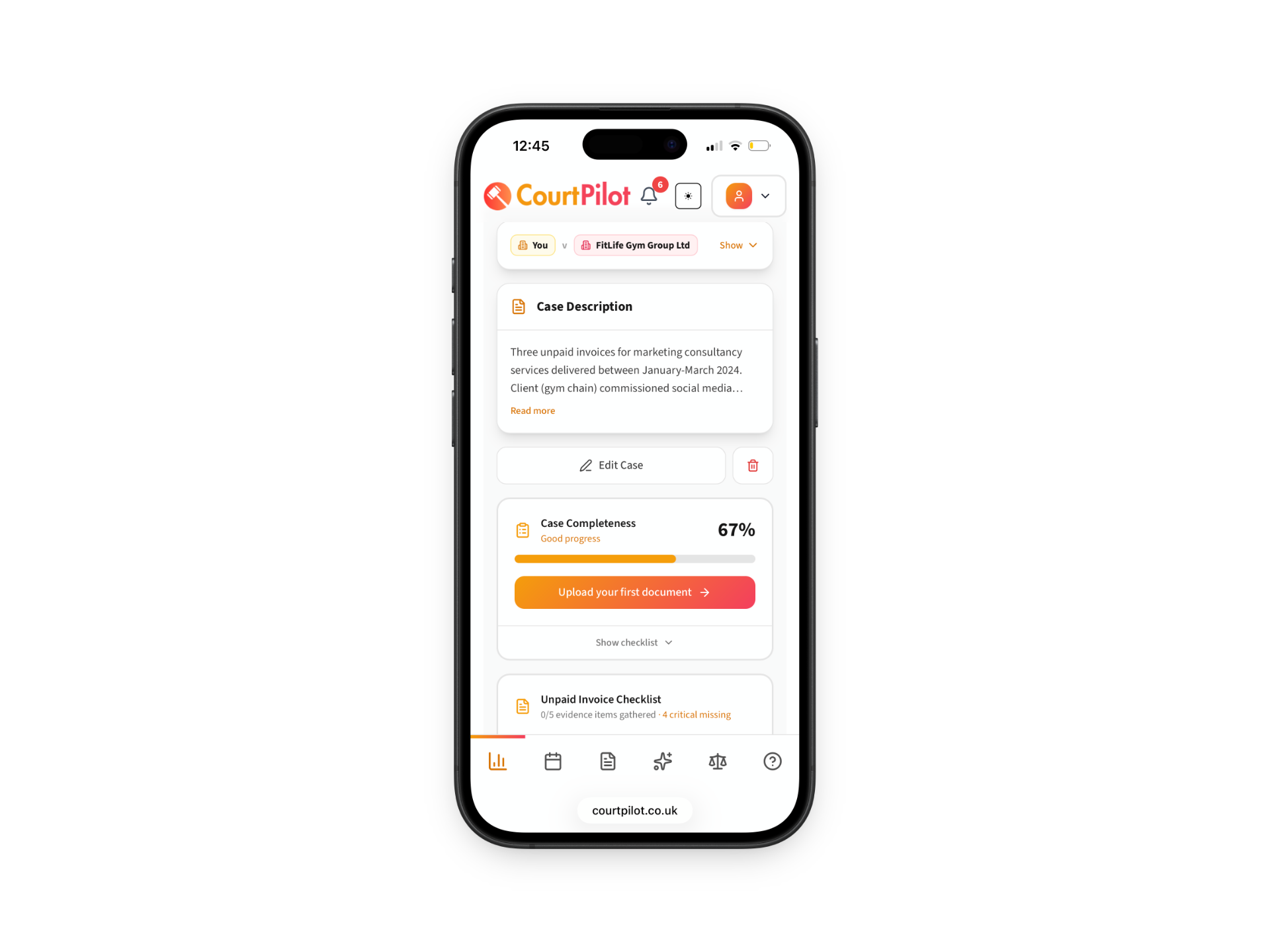
CourtPilot mobile case view for a sue car dealer matter
30 days
Short-term right to reject a faulty car for a full refund: Consumer Rights Act 2015 s.22.
6 months
A fault that appears within six months of delivery is presumed present at delivery, unless the dealer proves otherwise.
s.75
Consumer Credit Act 1974: a card or loan provider can be jointly liable for items with a cash price over £100 and up to £30,000.
Can you take this to court?

Five checks.
If most are yes, you may have a claim.

The Consumer Rights Act puts the burden on the dealer for faults that appear in the first six months, and an independent inspection can settle the technical argument.

1
You bought a car from a dealer (not a private seller) that turned out to be faulty.
2
The fault was there when you bought it, or appeared within the first months of ownership.
3
The dealer has refused to refund, repair or replace.
4
You have evidence of the fault: an independent inspection, mechanic’s report or photos.
5
The amount you’re claiming is under £10,000.
· Eligibility self-check
✓You bought a car from a dealer (not a private seller) that turned out to be faulty.
✓The fault was there when you bought it, or appeared within the first months of ownership.
✓The dealer has refused to refund, repair or replace.
✓You have evidence of the fault: an independent inspection, mechanic’s report or photos.
The full guide

How to sue a car dealer for a faulty used car.

The rules that apply to a used car bought from a dealer, what changes if you bought on finance, and the step-by-step route to the small claims court in England and Wales.

Your rights when you buy a car from a dealer

A car bought from a dealer is "goods" under the Consumer Rights Act 2015, so it must be of satisfactory quality, fit for purpose and as described (ss.9 to 11). For a used car, satisfactory quality takes account of its age, mileage and price: you cannot expect a ten-year-old car to be perfect, but you can expect it to be safe and roadworthy and free of faults the dealer did not tell you about. Anything the dealer said or wrote about the car, such as the advert, the mileage or the service history, is part of the description.

These rights apply to used cars as well as new ones, and they apply against the dealer even if the car came with a separate warranty.

The 30-day and 6-month rules for cars

  • Within 30 days of taking ownership and delivery, you can use the short-term right to reject for a full refund (ss.20 and 22). Tell the dealer clearly, in writing, that you are rejecting the car.
  • After 30 days, you can ask for a repair or replacement (s.23). The dealer must do it within a reasonable time, without significant inconvenience, at no cost to you.
  • If one repair or replacement fails, you can ask for a price reduction or use the final right to reject (s.24).
  • Within six months of delivery, a fault is presumed to have been present at delivery for those later remedies unless the dealer proves otherwise (s.19(14)). After six months, you need to show the fault was there when you bought it, which is where an independent inspection matters.
  • Deduction for use. For most goods there is no deduction for use on a final rejection within six months, but cars are an exception: the refund on a final rejection can be reduced to reflect the use you have had (s.24(10) and (11)). No deduction applies to the 30-day short-term right to reject.

Bought the car on finance?

Hire purchase and PCP. Under a hire purchase or PCP agreement the finance company usually owns the car and supplies it to you, so your Consumer Rights Act claim is normally against the finance company rather than the dealer. Complain to the finance company in writing first. If you are not happy with its final response, or it has not replied within eight weeks, you can usually take the complaint to the Financial Ombudsman Service, which is free.

Credit card or a separate loan. If you paid part of the price by credit card, or with a loan the dealer arranged, and the cash price was over £100 and no more than £30,000, section 75 of the Consumer Credit Act 1974 can make the lender jointly liable with the dealer.

Finance claims can be technical. If the agreement is large or the paperwork is unclear, consider getting advice before you issue.

Step by step: from complaint to small claims court

  1. Stop driving it if it is unsafe, and record the fault. Note the mileage and the date the fault appeared, keep the advert, invoice, MOT and service records, and take photos or video.
  2. Get an independent inspection. A report from an independent engineer that describes the fault and says whether it was likely present at the sale is often the most important evidence. On the small claims track, expert fees of up to £750 can be recovered.
  3. Reject or complain in writing. Write to the dealer (or the finance company, for HP or PCP) saying which right you are using and what you want. Within 30 days, say clearly that you are rejecting the car. If the dealer belongs to a scheme such as The Motor Ombudsman, you can ask whether it will look at the complaint.
  4. Send a letter before action. If that fails, send a formal letter before action following the Practice Direction on Pre-Action Conduct: the car, the fault, the evidence, the remedy and sum you want, and a reasonable deadline (14 days is common).
  5. Issue the claim online. If the deadline in your letter passes without payment, you can issue the claim yourself through Money Claim Online or the GOV.UK "Make a money claim" service. You state a fixed sum, a short description of the claim and any interest, and pay the issue fee. The defendant needs an address for service in England or Wales.
  6. Wait for the response. Once the claim is served, the defendant normally has 14 days to pay, admit, or file a defence, or 28 days in total if they file an acknowledgment of service first. If they do nothing, you can ask the court for judgment in default.
  7. Free mediation if it is defended. Most defended small money claims are now referred to a free one-hour telephone session with the HMCTS Small Claims Mediation Service before a hearing is listed. See our guide to mandatory mediation.
  8. Directions and the small claims track. If it does not settle, both sides complete a directions questionnaire and the court allocates the case. Claims up to £10,000 normally go to the small claims track, where the procedure is simpler and each side usually pays its own legal costs. The court then sets dates for exchanging documents and witness statements, and you pay the hearing fee.
  9. The hearing. Small claims hearings are informal and often short. A district judge reads the papers, asks both sides questions and gives a decision, usually the same day. Our guide to what to expect at the hearing covers the day itself.
  10. Judgment and enforcement. If you win and they still do not pay, the court has enforcement options such as a warrant of control or an attachment of earnings order. Each has its own fee.

Bought from a private seller?

The Consumer Rights Act 2015 does not apply to private sales. A private seller must still sell a car that matches its description, and if they made false statements that persuaded you to buy, you may have a claim for misrepresentation. Those claims are harder, because there is no implied term of satisfactory quality and no six-month presumption.

Court fees to sue a car dealer

You pay the issue fee when you start the claim, and the hearing fee only if the case is defended and listed for a hearing. Many used-car claims fall in the top small claims band. Use the court fee calculator for your exact figure.

The issue fee runs from £35 for a claim up to £300 to £455 for a claim of £10,000. If the case goes to a hearing there is a second fee, from £27 to £346 on the small claims track. See the full fee table by claim amount or use the court fee calculator for your exact figure.

Fees from the HMCTS fee list (EX50), last checked against gov.uk on 2026-10-19. Fees change, so check gov.uk before you pay. If you are on a low income you may qualify for Help with Fees (form EX160). Court fees you pay are normally added to the claim and can be ordered against the other side if you win.

Worked example

i
Illustrative example · not a real customer

Alex buys a used hatchback from a dealer for £6,500, paying by bank transfer. On day 20 the gearbox starts slipping. An independent inspection says the fault is long-standing and would have been present at the sale.

Because it is within 30 days, Alex writes to the dealer the same day rejecting the car under the short-term right to reject and asking for a full refund. The dealer offers only a repair. Alex sends a letter before action with the inspection report, and when the deadline passes, issues a claim for the price.

Price paid (short-term rejection, no deduction for use)£6,500
Court issue fee£455
Hearing fee, only if defended and listed£346
Interest8% simple under s.69, from the date of rejection

This illustrates the method only. It is not a prediction of the outcome of any real case, and a dealer may dispute whether the fault was present at sale.

CourtPilot is not a law firm and this page is general information about the law in England and Wales, not legal advice. If your situation is complicated or the sum is large, consider speaking to a solicitor or Citizens Advice.

What CourtPilot drafts for you

Tuned to your car.
Not a template.

Generic complaint letters don’t name the right being used or bring in the finance company. CourtPilot drafts to CRA 2015 ss.19 to 24 and, where it applies, the Consumer Credit Act route.

1
Letter Before Action — Names the vehicle, the fault, the CRA right being exercised and the deadline, following the Practice Direction on Pre-Action Conduct.
2
Fault timeline & inspection summary — Mileage, dates, what was said at sale and what the independent inspection found: the chronology the court will look at first.
3
Particulars of Claim — Pleaded to CPR Part 16, citing CRA 2015 ss.9 to 11 and ss.20 to 24, and s.75 Consumer Credit Act 1974 where it applies.
4
Witness statement & court bundle — Your account with the invoice, inspection report, correspondence and photos exhibited, indexed and paginated for the hearing.
9:415G
Letter Before Action×
DRAFT · USED CAR DISPUTE
Re: Faulty 2019 hatchback, refund under CRA 2015 s.20

Dear Sirs,

I write before issuing a claim in the County Court Money Claims Centre. On 7 April 2026 I purchased a 2019 hatchback from you for £7,895. Within 18 days the dual-mass flywheel failed; an independent inspection on 28 April says the fault was present at the point of sale.

I exercise my short-term right to reject under Consumer Rights Act 2015 s.20 and require a full refund within 14 days…

Refund
£7,895
Days used
18
Statute
CRA s.20
Deadline
14 days
Download Word doc →
The cost of being heard

Solicitors are expensive on used cars.
CourtPilot is one fee.

On a £7,000 used-car claim, a solicitor’s fee can eat much of the refund, and on the small claims track legal costs generally aren’t recoverable. CourtPilot is one flat price.

What a solicitor charges
By the hour
Billed for the time spent
A solicitor bills for their time on a used-car claim. Expert fees up to £750 can be recovered on the small claims track; solicitor fees generally can’t.
What CourtPilot charges
£49
One-off · the lot
LBA citing CRA 2015 (and the Consumer Credit Act where relevant), fault timeline, particulars, witness statement, MCOL walkthrough, court bundle. One-off. The £29 Claim Pack is credited against it within 60 days if you started there.
What changes
Nothing
You’re still the claimant
Same court, same forms, same procedure. You sign and file. We draft, walk you through MCOL, and produce the bundle.
Pricing, in one breath

£29 today. £49 if it goes the distance.

Start with the Claim Pack: the letter, plus the particulars and the N1 ready if they don’t pay. Most disputes settle once a proper letter lands. If yours is defended, the £29 comes off the toolkit within 60 days — same total either way.

01 · Today
£29
Claim Pack: letter, particulars and N1
Drafted from your invoice and the inspection, citing the section of the CRA you’re relying on and the deadline.
02 · If they don’t settle
£49
£20
Upgrade to the full toolkit
MCOL walkthrough, particulars, fault timeline, witness statement, court bundle, hearing script. £29 Claim Pack credited within 60 days.
03 · Included
Free
Finance-claim helper
Bought on HP, PCP, a credit card or a dealer-arranged loan? We help you work out whether the claim lies against the finance company.
The questions people ask

The bits people always ask.

Can I sue a car dealer for selling me a faulty car?+

Yes. If you bought from a dealer as a consumer, the car must be of satisfactory quality, fit for purpose and as described under the Consumer Rights Act 2015. If the dealer will not refund or repair, you can issue a money claim in the County Court, and claims up to £10,000 normally go to the small claims track.

What is the 30-day right to reject a faulty car?+

Under Consumer Rights Act 2015 ss.20 and 22, you have 30 days from taking ownership and delivery to reject a faulty car for a full refund. You do not have to accept a repair first, and no deduction for use is made.

What if the fault appears after 30 days?+

You can ask for a repair or replacement under s.23. If that fails, you can ask for a price reduction or use the final right to reject under s.24. Within six months of delivery the fault is presumed to have been present at delivery unless the dealer proves otherwise. For cars, a refund on final rejection can be reduced for the use you have had.

Can I claim against a private seller?+

The Consumer Rights Act 2015 only applies to purchases from a business. A private seller must still sell a car that matches its description, and you may have a misrepresentation claim if they made false statements, but these claims are harder to win.

What if I bought the car on finance?+

Under hire purchase or PCP, the finance company usually supplies the car, so your claim is normally against it, and you can take an unresolved complaint to the Financial Ombudsman Service. If you paid by credit card or a dealer-arranged loan and the cash price was over £100 and up to £30,000, section 75 of the Consumer Credit Act 1974 can make the lender jointly liable.

Do I need an independent inspection?+

It is not compulsory, but a report from an independent engineer that describes the fault and whether it was likely present at sale is often the strongest evidence. On the small claims track, expert fees of up to £750 can be recovered if you win.

Two minutes · No card

Find out the cleanest route for your car dispute.

The free case check tells you whether you’re inside the 30-day reject window, who to claim against, and the next step. No card required.