
Money owed · England & Wales · Small claims under £10,000

Sue for money owed.
Through the small claims court.

Lent money to a friend, family member or acquaintance who won’t pay you back? A verbal loan can still be a binding contract. Here’s how to file a small claim yourself, and how CourtPilot drafts the letter, the particulars and the bundle.

We help you prepare the documents and file them yourself — you’re always the claimant on the record. Not a law firm, no legal advice given.
✓ Verbal agreements can be enforced
✓ s.69 interest at 8% claimable
✓ No solicitor required
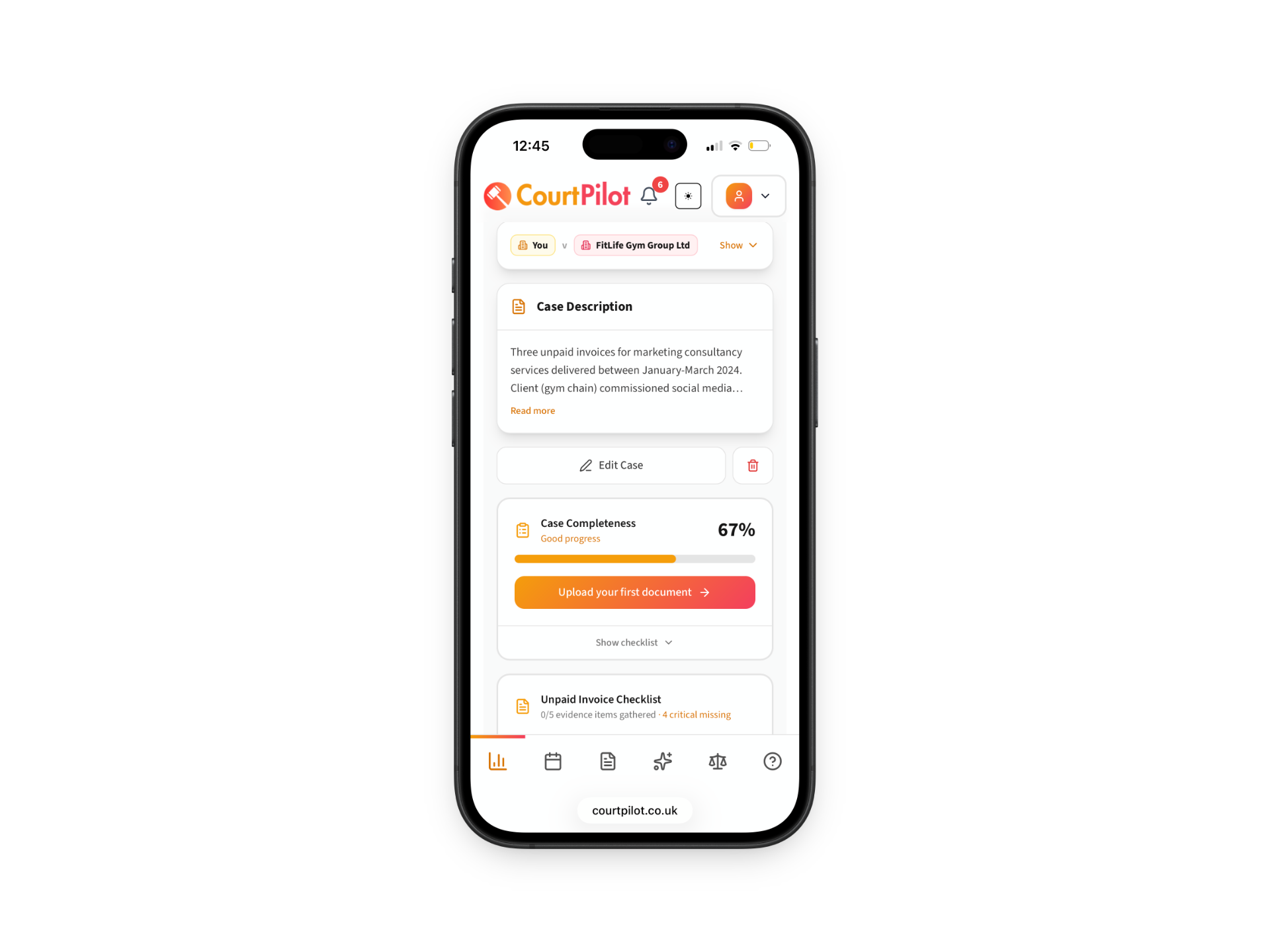
CourtPilot mobile case view for a sue for money owed matter
6 years
Limitation period for a simple contract debt under the Limitation Act 1980.
8%
Simple interest a court can award under County Courts Act 1984 s.69, if you claim it.
£10,000
Normal upper limit of the small claims track, designed for people representing themselves.
Can you take this to court?

Five checks.
If most are yes, you may have a claim.

Many personal-loan disputes turn on evidence rather than law. A bank transfer plus messages discussing repayment goes a long way.

1
You lent money to someone who agreed, verbally or in writing, to pay it back.
2
The borrower has missed the agreed repayment date or is ignoring you.
3
You have some evidence of the loan: a bank transfer, messages, or a witness.
4
The amount owed is under £10,000.
5
You’ve asked for the money back and been refused or ignored.
· Eligibility self-check
✓You lent money to someone who agreed, verbally or in writing, to pay it back.
✓The borrower has missed the agreed repayment date or is ignoring you.
✓You have some evidence of the loan: a bank transfer, messages, or a witness.
✓The amount owed is under £10,000.
The full guide

How to file a small claim for money owed.

The time limits, the letter you must send first, the court fees, and each step of the small claims court process in England and Wales.

Is it a debt the court can order them to pay?

To win, you need to show on the balance of probabilities that the money was a loan that had to be repaid, not a gift, and that it is now due. A written agreement helps but is not required: bank transfers with a reference such as "loan", messages discussing repayment, and any part payments are all evidence.

If the borrower says it was a gift, the court looks at everything said and done at the time. Messages where they acknowledged owing you, or repayments they made, are often decisive. Our private loans guide covers the evidence in more detail.

Time limits: the 6-year rule

  • Under section 5 of the Limitation Act 1980, you generally have six years from the date the money became due to issue a claim.
  • If there was no fixed repayment date (a loan "repayable on demand" or "pay me back when you can"), section 6 says time usually runs from when you make a written demand for repayment. That is one reason to put your demand in writing.
  • If the borrower acknowledges the debt in writing and signs it, or makes a part payment, the six years can start again from that date (sections 29 and 30).

Limitation rules have exceptions. If the debt is close to six years old, consider getting advice before you rely on it.

The letter before action you must send first

Before you go to court, you are expected to send a letter before action. Which rules apply depends on who you are:

  • You are an individual claiming from an individual (for example, a loan to a friend): follow the Practice Direction on Pre-Action Conduct. Set out how much is owed and why, ask for payment by a date, and give a reasonable time to respond. For a simple debt, 14 days is common.
  • You are a business claiming from an individual (including a sole trader): the Pre-Action Protocol for Debt Claims applies. You must give at least 30 days to reply and include an information sheet and reply form. See our unpaid invoice claims page.

If you ignore these rules, the court can penalise you on costs or interest, even if you win.

How to file a small claim, step by step

  1. Gather your evidence. Bank statements showing the transfers, messages or emails about the loan and repayment, any written acknowledgment, and a list of any repayments. Note the date the money became due.
  2. Check they can pay. A judgment is only worth what you can enforce. If the borrower has no income or assets, think carefully before spending money on court fees.
  3. Send the letter before action. Use the right pre-action rules for your situation (see above), keep a copy and proof of sending, and wait for the deadline to pass.
  4. Issue the claim online. If the deadline in your letter passes without payment, you can issue the claim yourself through Money Claim Online or the GOV.UK "Make a money claim" service. You state a fixed sum, a short description of the claim and any interest, and pay the issue fee. The defendant needs an address for service in England or Wales.
  5. Wait for the response. Once the claim is served, the defendant normally has 14 days to pay, admit, or file a defence, or 28 days in total if they file an acknowledgment of service first. If they do nothing, you can ask the court for judgment in default.
  6. Free mediation if it is defended. Most defended small money claims are now referred to a free one-hour telephone session with the HMCTS Small Claims Mediation Service before a hearing is listed. See our guide to mandatory mediation.
  7. Directions and the small claims track. If it does not settle, both sides complete a directions questionnaire and the court allocates the case. Claims up to £10,000 normally go to the small claims track, where the procedure is simpler and each side usually pays its own legal costs. The court then sets dates for exchanging documents and witness statements, and you pay the hearing fee.
  8. The hearing. Small claims hearings are informal and often short. A district judge reads the papers, asks both sides questions and gives a decision, usually the same day. Our guide to what to expect at the hearing covers the day itself.
  9. Judgment and enforcement. If you win and they still do not pay, the court has enforcement options such as a warrant of control or an attachment of earnings order. Each has its own fee.

Claiming interest on money owed

Unless your agreement set its own rate, you can ask the court for simple interest at 8% a year under section 69 of the County Courts Act 1984, usually from the date the money was due. You must claim it on the claim form, with the total to the date of issue and a daily rate going forward. The award is at the court’s discretion. The interest calculator works out both figures.

The separate Late Payment of Commercial Debts (Interest) Act 1998 rate only applies between businesses.

Small claims court fees for money owed

The issue fee is based on the total you claim, including interest, and is paid when you file. The hearing fee is only payable if the claim is defended and listed for a hearing. Use the court fee calculator for your exact figure.

The issue fee runs from £35 for a claim up to £300 to £455 for a claim of £10,000. If the case goes to a hearing there is a second fee, from £27 to £346 on the small claims track. See the full fee table by claim amount or use the court fee calculator for your exact figure.

Fees from the HMCTS fee list (EX50), last checked against gov.uk on 2026-10-19. Fees change, so check gov.uk before you pay. If you are on a low income you may qualify for Help with Fees (form EX160). Court fees you pay are normally added to the claim and can be ordered against the other side if you win.

Worked example

i
Illustrative example · not a real customer

Jordan lends a friend £2,400 by bank transfer with the reference "loan", and the friend replies by text: "I'll have it all back to you by 1 March". By then only £400 has come back, and the friend stops replying.

Jordan sends a letter before action giving 14 days, following the Practice Direction on Pre-Action Conduct. Nothing comes back, so Jordan files a claim online 214 days after the money was due, claiming the balance plus 8% simple interest.

Balance owed£2,000
s.69 interest (8% for 214 days)£93.81
Daily rate after issue£0.44
Total claimed£2,093.81
Court issue fee (added to the claim)£115
Hearing fee, only if defended and listed£181

Figures are calculated from the current fee table and simple 8% interest. They illustrate the method only and are not a prediction of any outcome.

CourtPilot is not a law firm and this page is general information about the law in England and Wales, not legal advice. If your situation is complicated or the sum is large, consider speaking to a solicitor or Citizens Advice.

What CourtPilot drafts for you

Tuned to your loan.
Not a template.

Generic templates fall over the moment the borrower says “it was a gift”, “I already paid you back”, or “there was never a deadline”. CourtPilot drafts from your transfers, messages and dates.

1
Letter Before Action — Names the loan, the dates, the s.69 interest and the deadline, under the pre-action rules that fit your situation.
2
Bank-transfer schedule — Itemised list of transfers and repayments with references and dates: the evidence the court looks at first.
3
Particulars of Claim — Pleaded to CPR Part 16: the agreement, the breach, the sum due and the interest claimed.
4
Witness statement & court bundle — Your version of events with messages and transfers exhibited, indexed and paginated for the hearing.
9:415G
Letter Before Action×
DRAFT · DEBT CLAIM
Re: Repayment of personal loan, £3,200

Dear Mr Atkinson,

I write before issuing a claim in the County Court Money Claims Centre. On 14 May 2025 I transferred £3,200 to your account, ref “loan”. You agreed in writing on 12 May 2025 to repay this sum by 30 September 2025.

In accordance with the Practice Direction on Pre-Action Conduct, this letter gives you 14 days to pay…

Loan
£3,200
Repayments
£0
Interest 8%
£21/mo
Deadline
14 days
Download Word doc →
The cost of being heard

Solicitors don’t scale to personal loans.
CourtPilot does.

On the small claims track, legal costs generally aren’t recoverable. Spending £2,000 in solicitor fees to recover £3,000 isn’t a win.

What a solicitor charges
By the hour
Billed for the time spent
A solicitor bills for their time on a debt claim, more again if it goes to a hearing, and on the small claims track those fees generally aren’t recoverable.
What CourtPilot charges
£49
One-off · the lot
LBA, particulars, transfer schedule, witness statement, MCOL walkthrough, court bundle. One-off. The £29 Claim Pack is credited against it within 60 days if you started there.
What changes
Nothing
You’re still the claimant
Same court, same forms, same procedure. You sign and file. We draft, walk you through MCOL, and produce the bundle.
Pricing, in one breath

£29 today. £49 if it goes the distance.

Start with the Claim Pack: the letter, plus the particulars and the N1 ready if they don’t pay. Most disputes settle once a proper letter lands. If yours is defended, the £29 comes off the toolkit within 60 days — same total either way.

01 · Today
£29
Claim Pack: letter, particulars and N1
Drafted from your transfers and messages. Names the sum, the s.69 interest and the deadline.
02 · If they don’t settle
£49
£20
Upgrade to the full toolkit
MCOL walkthrough, particulars, transfer schedule, witness statement, court bundle, hearing script. £29 Claim Pack credited within 60 days.
03 · Included
Free
Interest calculator
Built in. Drop in the dates and the amount and we produce the running s.69 figure for the letter and the particulars.
The questions people ask

The bits people always ask.

How do I file a small claim for money owed?+

Send a letter before action first. If the deadline passes without payment, issue the claim online through Money Claim Online or the GOV.UK money claim service, state the sum and any interest, and pay the issue fee. Claims up to £10,000 normally go to the small claims track.

Can I sue without a written contract?+

Yes. A verbal agreement to lend and repay money can be a binding contract. Bank transfers, messages about the loan, part repayments and witnesses can all prove what was agreed.

How long do I have to sue for money owed?+

Generally six years from when the money became due, under the Limitation Act 1980. If there was no fixed repayment date, time usually runs from your written demand. A signed written acknowledgment of the debt or a part payment can restart the six years.

Can I charge interest on money owed?+

Yes, if you claim it. The court can award simple interest at 8% a year under section 69 of the County Courts Act 1984, usually from the date the money was due. You state the total to the date of issue and a daily rate on the claim form.

What if they say it was a gift, not a loan?+

It is a common defence. You need to show repayment was expected: messages about when they would pay you back, any part repayments, or witnesses to the agreement.

What happens if they ignore the court claim?+

If the defendant does not respond within the time allowed, usually 14 days after service or 28 days if they acknowledge service, you can ask the court for judgment in default. If they still do not pay, you can apply to enforce the judgment.

How much does the small claims court cost?+

You pay an issue fee when you start and a hearing fee only if the claim is defended and listed for a hearing. Both depend on the total you claim, including interest, and are shown in the fee table on this page. If you win, the court normally orders the other side to repay them.

Two minutes · No card

Find out whether your money claim stacks up.

The free case check tells you whether the evidence stacks up, what to claim including s.69 interest, and the next step. No card required.